
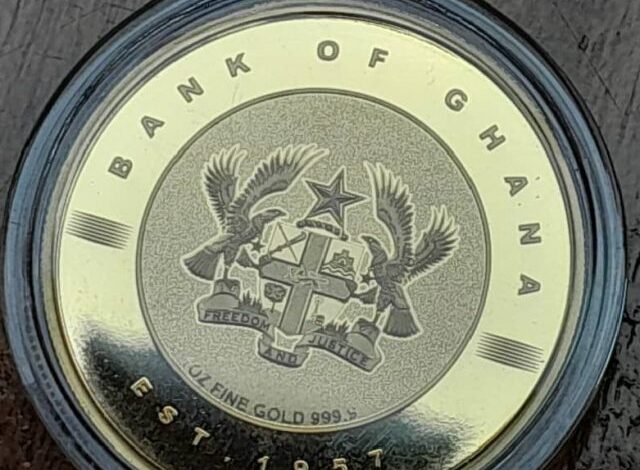
On Friday, September 27, 2024, the Bank of Ghana made a bold move by introducing a gold coin as a store of value, aiming to counter the rapid depreciation of the cedi. This initiative provides investors an alternative to the US dollar, hoping to ease the pressure on Ghana’s struggling currency.
However, doubts loom over this strategy, particularly given the comparison to Zimbabwe’s recent launch of the gold-backed currency, the ZiG (Zimbabwe Gold). Introduced with high hopes in April 2024, the ZiG saw a dramatic 40% loss in value within months. Zimbabwe’s experience offers a cautionary tale, highlighting that even gold, traditionally seen as a safe asset, may fail if underlying economic challenges persist.
Both Ghana and Zimbabwe have been grappling with inflation, though under different circumstances. In response to escalating inflation, the central banks of both nations have taken drastic measures, such as adjusting monetary rates. Ghana’s gold coin venture sparks optimism, but many investors remain wary, questioning whether it will succeed where others have faltered.
Zimbabwe: A Cautionary Tale of Hyperinflation
Zimbabwe’s struggle with hyperinflation is infamous. In 2008, inflation rates surpassed 1,000%, rendering the Zimbabwean dollar worthless and forcing the country to adopt a multi-currency regime centered on the US dollar and South African rand. Inflation returned when Zimbabwe reintroduced its own currency in 2019, surging again in 2022 to a staggering 255%. Despite inflation cooling to around 101% in 2023, Zimbabwe’s economic outlook remained bleak, plagued by mismanagement, corruption, and low investor confidence.
The launch of the Zimbabwe Gold (ZiG) in April 2024 was an attempt to control inflation by backing the currency with a precious metal. Initially, the gold-backed currency brought optimism, as gold typically promises stability in times of economic crisis. Yet, within months, the ZiG lost 40% of its value, proving that even a gold-backed currency cannot overcome deep economic instability or restore investor trust. Despite this, inflation has recently slowed, even showing signs of deflation in Zimbabwe.
Ghana: Navigating Inflation Post-DDEP
Ghana’s inflationary crisis, though less severe than Zimbabwe’s, has also been significant. Inflation reached around 54% in 2022, driven by external shocks like rising global commodity prices and internal challenges such as high debt levels and an overreliance on imports. The Bank of Ghana responded by steadily raising interest rates, with the monetary policy rate climbing to 30% by 2023, up from 14.5% in early 2022. Yet, inflation persisted above 40% throughout the year.
The Domestic Debt Exchange Program (DDEP), introduced in 2023, aimed to restructure Ghana’s debt, but it left lingering uncertainty. Investor confidence remains fragile, and the cedi has continued to weaken, prompting many to turn to foreign currencies. Now, the gold coin is positioned as a possible solution, offering a store of value that could curb the cedi’s depreciation and reduce demand for dollars. However, Ghana’s dependence on imports and slow export growth makes this a high-stakes gamble.
The Question: Can Gold Anchor the Economy?
The key question is whether gold can serve as a reliable anchor for the economies of Ghana and Zimbabwe. Zimbabwe’s experience with the ZiG casts doubt on this. Even a gold-backed currency couldn’t retain value when investor confidence collapsed. This raises concerns for Ghana’s new gold coin initiative, which could face the same challenges if the country’s structural economic issues remain unaddressed.
While gold has historically been a store of value in times of instability, its success as a stabilizing force depends on broader economic fundamentals, such as fiscal discipline, strong exports, and sound governance. Without these, gold risks becoming a short-term fix rather than a long-term solution.
Conclusion: High Stakes for Ghana’s Gold Gamble
Ghana’s decision to introduce a gold coin as a store of value is a bold step in response to its economic challenges. However, its success is uncertain. In a global context of economic instability, and with unresolved internal issues, gold alone may not be sufficient to stabilize the economy. Zimbabwe’s experience with the ZiG shows that backing a currency with gold cannot ensure stability if the economy’s foundation is weak.
Source : myjoyonline.com


